 “Ahh! Lost again!” Pancho writes in the small red notebook that we had bought down in Sallent De Gallego. It was the first day of our trek through the Pyrenean Mountain Range… a brain child that was mutually devised back in Madrid during another red wine and Casera siesta. We were actually pretty serious about the whole thing, having gone out to the Rastro marketplace to buy forty meters of mountain climbing rope.
Pancho continued. “I am going to learn how to read mapas topograficas if I have to get all my friends killed doing it.”
Originally, we had planned to march from Panticosa to reach Andorra La Vella. I knew something was wrong after crossing the third mountain pass of the day, when Pancho suddenly stopped in his tracks and mystically pointed to an unexpected hydroelectric dam. Its streaming mass of poles and wires speared up through the Gorge de Rio Gallego.
“Hijo de…” was all Pancho could say.
We were in low spirits, and the only thing to do was to pitch camp in a little clearing among a mass of twisted steel beams and bulldozer till. Dinner consisted of lentejas with spaghetti sauce. We mixed a little kelp powder into the tomate tintorato. After dinner, we threw the kelp powder away.
“Never trust a man with a Rastro compass.” Pancho wrote, “Actually, we went to sleep last night and some cabron changed the mountains around, making our maps useless.”
For Pancho, the idea was not to be on time or in-the-right-direction; it was to be “heroico.” How many Spaniards in the well-known bar, “La Viva Madrid” have crossed the highest mountain range south of the Alps? Outfitted with a set of Nikon cameras, we figured that as long as the film and gusto held out, we could create our own epic myth.
 In the morning, we walked back down the mountain along a toe-stubbing, hellish descent of switchbacks and aqueducts. Arriving in the same little town of Sallent de Gallego from whence we had started, we threw off our packs at the nearest bar to feast on bocadillos and canas de cervesa. Heady and well fed, we waited at the highway, hoping to catch a ride to Parque Nacional de Ordesa.
“If someone would just give us a lift,” I wrote, “We should reach the base of the Ordesa Valley in several hours; from there, we could hike like burros to the day’s campsite, eat dinner, and pretend that we had actually planned this detour.
With the addition of several hours’ hackysack practice, and a lift from a shepherd’s truck, we found ourselves semi-redeemed at the ranger’s station, a gravel parking lot at the base of Valle de Ordesa. The day turned dark as we hiked up the trailhead and into the mass of wilderness. By sunset, we had found a little clearing covered with fallen leaves. We threw our Rastro tarp onto the mass of soft foliage and fastened the lines to tree branches.
As we laid back in our sleeping bags, we stared out to the black sky and admired the blue flashes that reflected off the mountains around us.
“Que Piensas, Pancho?”
“Los Estrellas. Son muy brilliante, no?”
“Si.”
“Do you see those blue flashes?”
“Yes, they are from lightning. Do you smell the burn in the air?”
I sniffed, and I could smell the faint semblance to toy train sets and televisions mixed with a heavy pine scent. We fell asleep to the quiet trickling of misty raindrops over the tarp.
Waking up to a damp campsite, we both took the early morning’s call as a jump-start to our redemption. Pancho was happy enough to have cured a three-day’s case of hiker’s constipation.
“Ya estoy listo.” Pancho exclaims, stuffing the tin toilet paper container into my backpack.
 Making our way up the valley through the morning hours, the trail meandered through a myriad of waterfalls, each flowing into little pools, collecting, and spilling into new fresh blue ponds…. an infinity of granite bathtubs which led us east through the wide-open meadow below the foot of Mont Perdido.
The trail was still moist, and as we hiked up along the elevated plain, I could feel the sun’s rays bursting through the cloud layer. The wind picked up a bit, and we could see fog turning to cloud. Ahead stood the face of the continental rift dividing Spain from France–a precipitous wall of stone that towered high above the rising sun. The morning rays filtered through the mist, brightening the rising fog against the southern portion of the valley.
“Me Encanta!” Pancho yelled.
He turned around with a big smile on his Asturian face. He pointed to the mountain escarpment, its waters falling hundreds of meters; he planted a make-believe flag beside him in the moist soil, walked back to me, and spoke like a true Spaniard: nose to nose.
“Esto es Espana!” He said.
“Let’s go!” I replied.
Along the base of the falls, we encountered a group of elementary school children who stuffed several extra barras of Gallegan bread into our backpacks. They yelled to us as we commenced climbing the face that would take us five hundred meters above the elevated plain.
Cables were bolted into the rock. The wind blew strongly. Our cold hands gripped the cables as we hoisted ourselves over the ledges. Rocks lined with slippery green and orange lichen, I was thinking good thoughts for the bolts which held the cables into the mountain.
As we crested the face, we found ourselves before a barren rock plain. The whole landscape seemed devoid of life, except for the shrub outcroppings that lingered under boulders. We stopped at a crow’s nest along the ridge that overlooked the Ordesa Valley. The wind blew harsher. I took off my pack and searched for my parka shell, which I put on over my already thick layer of clothes. Pancho opened the journal to add another entry.
 “Hitch hiking through los montanas with two thousand dollars of camera equipment around Cliff’s neck and begging bread from a school teacher who probably drives a SEAT worth half of that….”
“Yes,” I added to Pancho’s dependent clause, “The traveling Romans are now going to Frog country over the top of the Pyrenees.”
We reached the Spanish refugio by five o’clock. The stucco building stood at fifteen hundred meters, and according to the Basques who sunned themselves in the fading sunshine, there was another seven hundred meters to go before reaching the summit. We found a washroom where several large basins filled with ice-cold snow melt pumped up waters from the surrounding streams. We took turns dunking our heads in the ice water, splashing ourselves with a piercing coldness that made our ears ring.
“Do you feel your skull contracting?” I said.
“Mis cojones!” was all that Pancho could reply.
We darned new clothes, combed our hair, and started out along the trail. Snickering, we commented on those compulsive French. Wearing crampons and snow gaiters in the middle of summer!
The wind blew stronger as the ascent continued. Looking at the rock formations along the trail, I noticed how the elements had carved the stone into a sponge-like surface. As the sun reached its zenith, we rounded a small pass to be struck by a plateau of unworldly beauty.
 Streams amid lunar rocks reflected a span of pink twister clouds as they passed like blimps over the mountainside. The ridge terraced down until it reached a ledge where it dropped severely. The granite shelf was layered and curved, forming a natural theater. Lush grass, as short as any golf course, covered much of the arena. The entire view of the Ordesa Valley lingered over the edge, revealing the height and distance along which we had traveled.
I threw off my pack and rummaged for as much color film as I could find. I skipped out along the boulders, my camera mounted to the tripod, strap swaying like a banner as I jumped from one terrace to another.
Setting the tripod down, I attached the telephoto lens. In the eyepiece I saw Pancho kneeling on the plateau’s edge. I zoomed in on his image. In the blowing wind, he seemed cemented to the rock. I focused and metered.
 I shot.
A long exposure, but it felt accurate. The dark silhouette in the fading magenta Aragonian twilight stared out to the fire glow of clouds along the horizon. I attached the wide-angle and shot a full roll, panning from one end of the theater to another.
The day dimmed below the measure of light, and we eventually made it back to our packs in twilight’s faint fiery glow. We had not yet set camp or eaten, so we quickly erected the tarp against a long granite wall, fastening the rope which apexed against growing harsh winds.
“New-age Architecture.” I commented.
Slipping into our warm sleeping bags, the wind gusted strongly against the tarp material, pressing solidly against our limbs. I broke out the notebook.
 “It’s cocktail hour at the Flintstone residence,” I wrote, “Where we are enjoying hors d’oeuvres and taking pictures of an amazing pink-champagne sky. The wind is blowing cold, but we have everything under the tarp, which is folded over like a taco and suspended like a sail. Inspiring.”
“Inspiring indeed.” Pancho adds. “Ha! The mortales at the refugio looked at us like we were loco, washing our chorizos in ice water and walking off to meet God.”
It was a rugged, windblown evening. Two grommets had popped off of the tarp’s mainstay, and in the bitter chill, Pancho had to pull the material back against fifty-knot winds that screamed through the granite theater.
The sun rose quickly with an eyeball-piercing brightness. The air was crisp, but the wind had lessened in force since the evening. Beyond the peaks, jet trails criss crossed in white patterns against the purple-clear sky. I could see vapor emitting from my breath. Snow covered the entire ridge above the theater. Pancho and I spoke little while we ate, cleaned, and packed.
 Morning proved to be a harried meandering along steep precipices, Pancho in his new red Spanish hiking boots, me in California beachwear. We greeted a team of alpinists on their way down to the refugio. Not only were they wearing crampon spikes, but they also carried pick axes. Trudging through the half-melted snow, I discovered that we should have brought more suitable equipment.
Pancho suddenly slipped.
Out of control, he slid down the snow-covered escarpment. I could see him, then his pack, tumbling downwards.
A rooster tail emitted from the bouncing snowball, and it came to a halt about a hundred meters below the trail. Pancho slowly stood up, apparently laughing. I rubbed my forehead and sighed; my Spanish wasn’t good when making unexpected phone calls.
“We should have thought to use the rope,” he says as he crawls back up.
“Yea, to bring me along with you.”
Great idea.
 Examining himself, he raised the side of his shorts to expose a strawberry large enough to be carcinomic. He had used the edge of the Nikon’s motor drive to stop the fall. Inspecting the camera, I saw that it had taken a beating. I suggested that we bring it back to Aqui Photo and say that it came new-out-of-the-box that way.
“It was good for something.” He replied.
 I put the camera around my neck and continued. We pounded up the steepness, closing in on the last hundred meters of the peak. We could see the crest ahead. Low oxygen levels were taking their toll, and I could feel my legs burning. Pancho and I still hammered up the steepness, neck-and-neck. Just a little bit left, both of us heaving, sweat-soaked wool sweaters, my backpack feeling out of adjustment.
 Looking up from the snow before my feet, I saw it. Nostrils and eyeballs dilated, lungs aching, we had reached the summit.
Above the clouds, we looked up to the purple sky, that doorstep into the blackness of space itself. I flung off my backpack and walked out to the edge of the world. The cloud layer looked like a long, endless valley of white, and faintly visible, I could see the green of the land below. I pulled off my parka shell, tossed it onto the snow, and sat down in the brilliant midday sunshine. Pancho did the same, handing out the bread, sausage, and cheese. Tearing off large bread chunks, we ate lunch like true heroes, washing the food down with ice-cold mineral water that we had bottled from last night’s campsite. Looking east along the ridge of mountain peaks, Spain lingered to the right and France to the left.
At three thousand meters, never had I felt so high in the air. Never had my eyes seen such an unobstructed view. The clear, unspoiled sky magnified the bigness. The whole world was out there, like I could gather it up in my arms. I looked over to Pancho who just smiled.
The other side of the mountain was a large snow-covered bowl, and at the base stood the French refuge. We packed up again and started our descent. Looking down the steep, snow-covered slope, I think Pancho was having flashbacks to his fall.
 After several trepidous traverses down the mountainside, I gradually became aware of approaching footsteps. Across the slope, a bearded man bounded down the fall line, leaping with huge strides as he passed next to us. Pancho and I looked at each other.
“Madre mia!” He said.
“Nos Vamos!” I replied.
I followed after the trailblazer, stem cristiing down the powder snow. Trying to run, ski, hold on to two cameras, carry a fifty kilo pack, and stay on top isn’t easy, but it’s one of the greatest things you can do with your clothes on.
 We reached the cement patio of the refuge, brushing the powder snow off of ourselves. We took off our soaked hiking boots to let them dry in the afternoon sun. The refuge stood on a large concrete slab that overlooked the green valley and the half circle of waterfalls known as “L’ Cirque de Gavarnie.”
According to the ranger who spoke Catalan, the trail would lead us down two thousand meters, over broken terrain, macadam, in his words, “gravel” in English.
Dangling our feet over the patio ledge, Pancho opened the notebook and wrote, “Cliff’s marchara incrementa en Los Pyreneos was bouncing like a ballet dancer down the soft snow. Mine was sliding out of control down the icy glacier, looking at 500 meters below. I thought I was on a ride for the whole way down.”
He handed me the notebook. I laughed and added my piece.
“La Marchara Incrementa”, as Pancho describes it, relates to a mode of existence in which the traveler elevates himself from expectations of destination. Instead of fixating his mind on the journey’s end, he follows fate. The idea is not to arrive, but to move from one ‘increment’ to the next; proximal destinies are never reached since the traveler constantly changes his outlook.
“Yet, reading Pancho’s last entry and listening to the Frenchman’s macadam premonition doesn’t give me much faith in existential theories. Hairy traverses along foot-wide, gravel covered ledges with five-hundred foot drops puts my faith in pure determination.”
“Let’s do it,” Pancho says, smelling of stale bread and liver pate.
As one of the few passes across the Pyrenee range, the snowmelt from Le Tette Pyrenee collects into many creeks, which run to larger streams that eventually flow through waterfalls down the faces of rock that surround the valley below.
Making our way along this wet, perilous trail, we had time enough to capture the cirque’s massive beauty before stumbling over loose boulders that fell like bouncing balls down the escarpment. There were no guardrails, only dizzying heights and sections of trail suited only for goats or compulsive Frenchmen. During the whole harried descent, Pancho and I planned our triumphal menu of gourmet delights: a freshly-baked baguette, some bleu, brie, ementhal, and gruier cheeses, fine foi gras, ham, some sweet peaches, an orange or two, and two bottles of province wine.
The trail bottomed out to a fire road that led along a rushing river where the air smelled of horse manure and wet grass. The faint mist of the river’s whitewater cooled the sweat on our faces, and we could feel civilization near.
Little did we know the day before, as we attempted our frontier crossing, that we would not find a single place to exchange Spanish currency. Not only that, we didn’t know what day it was.
“Esta Sabado.” Pancho demanded.
We also had yet to experience being stranded with several thousand unwanted pesetas, a burned-out American Express Card, and absolutely no Francs.
“Today is Domingo.” I countered. “Everyone is either drunk or at church.”
Walking through the streets of Gavarnie, we were impressed by the sights and smells of the shops and restaurants, which beckoned our tourism, but by the time we had thoroughly combed the streets and horsetrails, we were simply distressed. We sat down in an open pasture along a low wall beside the river. Busloads of tourists passed by. We could see them–cheap French hats and sunglasses that stared at us through the windows.
“Let’s check our wallets again.” I urged.
Dismantling our billfolds for the second time, piece-by-piece, we were amazed to find that Pancho had hidden a twenty-dollar note in his wallet’s lining.
“A trick pocket.” He commented.
Having done another scouring of the town, we found ourselves before the only shop in Gavarnie disposed to cash American currency–a perfumerie.
Stepping into the delicate boutique, we were immediately greeted by a plethora of odors, which saturated the whole of the establishment. Behind the counter, a ruby-haired, rotund French girl with rosy cheeks greeted us as she spoke in her native tongue. Standing before us in her long paisley garment, this woman seemed to have appeared like a ghost from the seepage of scented waters on the shelves around her.
We tried to communicate back to her in French, which proved impossible; Pancho tried Spanish; I tried German; Pancho then threw out some phrases in Russian; and when these all failed, we tried English.
“Ah! You are American!” She exclaimed.
So much for being multi-lingual.
She proceeded to cash the money as we stood there, Pancho railing off the various adventures in broken syntax. Airs of trivial accomplishment and two-and-a-half-day-old trail musk were ruining the shop’s fragrance, yet the cheery cheeks behind the counter dimpled and blushed.
“Yes,” she said to me, “I believe the exchange rate is more or less eight francs to the dollar. With twenty dollars, it equals about two hundred francs. Does that sound right to you? I think you could use a little extra….”
She discarded the slip of paper upon which she had calculated her numbers. Having lived in Paris for two months, I was aware of the rate.
We didn’t argue.
“Are you French?” I asked.
“No,” she replied, “My Father is Belgian and my mother is Irish.”
Looking at her glowing face, she reminded me of Renoir’s coquette, the one in the restaurant scene, where she is ten women at once, a fountain of different expressions, constantly changing with the breeze of emotion. Charisma flowed from her, and it seemed perfectly obvious that she was a product of her environment.
As Pancho resumed his involved description of our debauched travels, sparing little in overexaggeration, I realized that he couldn’t be more of an antithesis to this plump, flowery Mademoiselle–boisterous, bombastic, and bullish.
“I invite you two to dine with me tonight.” She said.
More than flattered, we were hungry. We accepted our friend’s offer with newly found gusto. She said her name was Carrie, and she told us to meet her in the brasserie at six. We adjourned, Pancho thanking Carrie by kissing her hand before leaving the shop. We made an all-out run for the market once beyond sight.
“Pues,” Pancho writes in the journal, “Forget misadventure in the mountains. Let us concentrate on our knack of finding wealthy girls from Antwerp who care for wandering foreigners.”
I concluded, “We were having a classic dilemma in incremental travel–France. We have managed to land in a tourist town on a holiday weekend with damned little American cash, no bank, and only one market to replenish our supplies to continue The Search for the Great Pyrenean Dream.
“After spending half of our newly-found treasure on wine, meats, cheese, and fruit, hard times seem to be upon us again. With only a hundred francs to our coffer, we are holding conference on future debentures in food commodities.
“Do you think they sell peanut butter and jelly around here?” I speculated.
Meeting Carrie in the brasserie, she ordered us several rounds of Alsacian beer. We were accompanied by the bartender who professed to have learned English by watching every television episode of “Night Rider.”
“Gavarnie is a very boring place,” he told us as he filled Pancho’s glass.
“Why?” Pancho returned.
“We have only visitors for the day,” Carrie replied, “People who come in for the afternoon… large tour groups who stare at the mountain and take pictures, buy cheap perfume, then get into their tour busses and drive back to Lourdes.” The bartender stole my glass and refilled it . You would never believe it,” he said, “but our Carrie was once a butcher.”
“Silence, sil vous plez!” Carrie pleaded in her comic way.
As the bartender described various meat-hacking rituals, I couldn’t imagine this jolly flower with a couteau in her hand, hacking away at a cow’s carcass. Pancho and I having lived on cheese and nuts for most of the journey only made it worse.
The bartender continued his dramalogue. “Having left her Parentage Malveillant, she found herself in the Bucherie, slicing meats, since the only education she received was in Haute Cuisine.”
Though the bartender’s English was broken, he played to us with a seasoned sharpness. I also appreciated his generosity with the beer tap.
“She worked hard and saved enough money to travel to the French frontier,” he said, “Here, to this small village of Gavarnie she met Jean, a Ranger, who is stationed atop Mont Perdu, the highest peak south of the Alps. Did you not know that it is covered in snow three-hundred-and-sixty-five days a year?
“Really.” I replied, feeling comical with his Gaelic accent and tour-brochure style. The beer was draining into my head, and I looked over to Pancho who had his arm around Carrie’s shoulder.
“Jean comes off the mountain once every season to stay briefly….”
“Let’s have some dinner.” Carrie interrupted. “There is a fine Alsacian Brasserie up the street that serves the best food in the area.”
We stood up and said goodbye to the bartender. He was all smiles. Pancho thanked him, and he helped with his backpack. I noticed that nobody paid the bill, but Carrie rushed us out before we could protest.
We walked along the river towards the Cirque. We crossed the river and headed up a path that turned to granite steps. Trees lined the way, and floodlights beamed into the shrubbery, casting branch shadows on the shiny rock. The wind blew warmly, and it shook the leaves. Walking up to the entrance of the chalet and stepping inside, it seemed as though we had found ourselves in a place centuries before our time. Snowshoes hung on knotty pine walls, small linen-covered tables surrounded a hearth which spanned an entire wall. Logs blazed within the cavernous fireplace. The wood popped and hissed while the gentle clatter of a busy kitchen, with its smells of roasting pork and butter melted us into our seats.
Carrie ordered three grenadine-and-champagne cocktails. Lifting the fluted glasses, we toasted ourselves to an oncoming evening of fine food and pleasant drunkenness. Carrie ordered each of us our dishes, Pancho and I having waived our tastes to her discretion.
If it was rattlesnake, it was the finest that I had tasted, though Carrie informed me that it was a river fish common to the area, cooked with magical seasonings, some of which could be found on the shelves of the perfumerie itself. Pancho was ordered medallions wrapped in smoked pork. It arrived at the table sizzling.
“Dios Mio!” Pancho exclaimed.
We all laughed.
Carrie had poulet. She cut off two pieces and placed them on our bread dishes; it tasted of orange and sherry. For dessert, confiture de glaces made with ice cream churned in village creamerie. Pancho kept our glasses well filled with a mild white wine.
Afterwards, brandy arrived in warm glasses. We raised them up to our mouths. Vapors tingled nasal passages and liquid streamed glowingly into the gut. We had hardly spoken a word since the meal arrived, and as Pancho and I watched Carrie stare at her snifter and twist the stem nervously, I could tell that something was forthcoming.
She paused for a moment, still looking down at the bowl-like glass. She glanced up. “As you know,” she said, “Jean and I see very little of each other. Because we are not together always, it makes it much more special when we are.”
I saw her eyes sparkle and cheeks glow red. I looked at Pancho who stared intently, his hand next to hers on the table.
“Two months ago, Jean left for the mountain. I have not seen or heard from him since then.” She looked at us both. “This is not unusual, as it is much longer sometimes when we are not together. But now, there is something new.”
She paused and sipped her brandy. Pancho and I followed suit.
“Several days after he left, I fell ill. I could not explain this sickness, but later, I was to find what had really happened. You see, I have become pregnant.”
“How marvelous.”
“Que Bien!”
“Yes,” Carrie replied, beaming. “It is strange how the world moves. Le monde travaile.”
The waitress came over, and Carrie asked for the addition.
Carrie brought us out to the empty street that rambled along the closed shops. Once at the perfumerie, she directed us down a steep stairway that led to a doorway. She slipped a key into it, beckoning us to enter. Inside, the lingering perfume and domestic smells of bacon and wood blended into a cozy aroma. Carrie opened the window, and we were overwhelmed with the thunder of rushing rapids below.
“You should keep this open. The river has ions. They cleanse the soul.” She said softly.
Pancho followed Carrie into her bedroom, while I opened my pack and sorted through the mass of dirty clothes. I pulled my sleeping bag out, laid it on the floor next to the open window, and looked out through the dim night.
Carrie returned, leading Pancho by the hand while holding a candle with the other. She switched off the lights. Quietly, she placed the candle on the windowsill and retired into her room.
“Bon Nuit.” She whispered.
The moon glowed strongly through the blackness of the room, and the candle cast a long shaft of yellow into the cool whiteness of the moon and deep purple night. Cozy in my sleeping bag, no stones pinched my sides. I listened to the river and washed into sleep.
I woke in the morning thinking of Madrid. In my sleep, I had thought the fur rug was Siete, my Spanish German Shepherd who, in the apartment above Plaza Santa Ana, shared my room.
Water was running in the bathroom. In a moment, Pancho stepped out, wet and wrapped in towel. Carrie appeared from her room, dressed in plaid skirt and white flowing blouse.
“Adieu. I have to go upstairs to work. When you are ready, we can have petit dejoner,” she said, closing the door.
I looked over to Pancho who tossed me the half-wet towel.
“Shower yourself, you have the odor of two goats!”
I didn’t need to smell myself to know I was dirty. Moreover, last night’s chef spared little garlic in the entrée, and it seemed to blend with the musty aroma of my flesh. I jumped to and made for the hot shower. I could tell that I was dirty, owing to the brown cesspool, which swirled along the bottom of the bathtub and into the drainpipe. Toweling off, my whole body tingled with cleanliness.
Pancho was busy at work on a journal entry, and when I had finished dressing in a new set of clothes, he handed me the notebook.
“I will always remember our rugged mountain hikes into Gavarnie with pleasure.” He writes. “Not only were the mountains trez bien, but the sauce eschallot, glace poire, and apéritifs were excellent. Yes, the French Pyrenees will some day find their way into poetry.”
I was flabbergasted.
“Very colorful,” I commented, adding my piece. “We will be climbing out of Gavarnie today to chase another increment. It is not the horse dung in the streets that we will miss, nor the fat families from Lourdes who ride them up to the Cirque. Neither will we miss the testosterone-charged glory of coming down the mountainside, displaying alpine suntans and a virgin rope.
“Moreover, we have run into a first-rate lady who has stuffed our stomachs and offered us a warm place to sleep. We will not forget her hospitality. It complements our manhood.”
Upstairs, Carrie had the table set with a basket of croissants, a loaf of bread, butter, several types of jams and honey, and a boiling pot of coffee, which she poured for us into large bowls. The coffee quickly cleared my hangover.
“So, do you have any plan for the day?” Carrie asked.
“I think we could hike up over the pass.” Pancho replied.
“I’m game.” I added.
“Then where?” She said.
“We don’t know.” Pancho concluded.
Carrie poured herself half a cup and added some sugar, stirring it silently. It reminded me of last night, and it put me a little on-edge.
“I have a favor to ask of you.” She finally broke out.
Silence.
“Since you are going in that general direction, there is a trail which leads to the peak of Mont Perdu. Halfway to the top stands the refuge. There you can meet Jean, who would surely offer you free food and lodging.”
Pancho and I looked at each other–an interesting incremental proposition.
“I could write him a note, telling of our baby, and you could deliver it to him.”
“Yes.” We both replied.
Carrie got up excitedly and ran to her desk. She shuffled around for a moment, then returned with all the ingredients of a letter. She wrote in scribbles, then neatly folded the paper into thirds, and slipped it into an envelope, which she placed in front of us on the table. She got up again and went to the cash register. I heard the ringing of the till, and she returned with a bill, which she placed on top of the envelope. It was a hundred-franc note.
“I want you two to take this.” She said. “You need supplies to get back to Spain. Buy as many things as you wish. The market is open now.” She slid the money to Pancho, the letter to me. “Take it…it’s yours. Just do me that one favor.”
I took the envelope, mostly by impulse.
“If you want an expedition, you two deliver the message for me, okay?”
“Sure,” I said, trembling a little.
“Go.” She said. “I can clean up for you.”
Pancho and I walked out in the misty avenue. It was overcast. Soon we found ourselves in the small market where we combed the shelves for anything cheap and edible. Lu Lu wafers, raisins secs, peanuts, figs, and chocolat–good enough for a makeshift trail mix. A pint of whiskey (I figured we may need it at some point.) Tuna was not cheep, but I snatched up several tins anyway, along with some foi gras and capers. Pancho was in the cheese section, asking the frightened woman behind the counter to fill his plastic tub full of cheese.
“Cheese… Queso!” Pancho said loudly, as though volume would make her understand.
“Fromage.” I said.
“Si, Fromage.” Pancho echoed.
The woman smiled and began to point to various kinds.
…Several baguettes, shampoo, tooth paste, bic lighters, six cans of tomato sauce…. Checking the items through the register, the attendant stared at us as we stuffed the grocery bags full. Carrying my bag out into the street and feeling the weight, I realized that it would do us little good on a forty-percent grade. We had ten francs change left over, which was pocketed for later.
The morning was wearing away, and the weather remained misty and cool. In the shop, Carrie was shoveling a batch of freshly baked cookies into a big ziplock bag. Pancho and I went downstairs to gather our belongings. I cleaned my Nikon camera, and in doing so, realized that I had two shots left on the roll.
“Ya nos sacamos un foto.” I said.
“Muy Bien.” Pancho replied.
Dry boots, packs refilled to the brim with enough supplies to make it to the Antarctic, we ventured upstairs to take the last goodbye shot.
“Carrie, let’s take a picture.”
“No, I look terrible.”
“It would only take a second,” I implored, “I’ll send it back to you someday.”
“Well….”
We stood outside the perfumerie, the camera on its little tripod in the middle of the village street, the timer winding down the seconds as we held our smiles, arm-in-arm. We shot two exposures, which finished the roll, and I wound the cartridge back, opened the camera, and placed the roll into my Tupperware film box. I took her letter out of my pocket and placed it on top of the exposed rolls. I cleaned the camera back and loaded a fresh roll from the ever-dwindling reservoir of unexposed stock.
Carrie kissed us both on the cheek, as the French always do. We assured each other that we would write one another, having swapped addresses the day before.
“Adieu.” She said. “Bon chance!”
“Gracias,” Pancho said as he planted her a good one on the lips.
We laughed when she turned bright red.
Salutations continued well down the street until we could no longer hear each other. It was ten o’clock. Passing the ranger’s station, I looked up the mountain, wondering how high we could get by lunchtime. The sky remained dark as we rose above the valley, switching back and forth into the treeline.
“How about up to the right there?”
“No. Too steep.” Pancho replied.
On a plateau above the valley, our eyes strained to pierce the mass of fog that had surrounded us. Ahead lay several trails to which destinations we had no clue.
“What about the ridge over there to the left? That has to be….”
“No se. The trail to the right could be the one.”
“How ’bout straight ahead up that face.”
“Goat trail.”
“But look, there’s some tracks or something.”
“Listen,” Pancho said in Spanish, “Grandmothers climb this trail. Does that look like anything less than a grandmother’s trail?”
 We continued the ascent in between the left and center trails, hoping that it would bring us far enough south without losing compass bearings. We began to enter thick cloud layer, and with each stride, I struggled to sense a change in light. Yet, I knew we were close to breaking through. The trail shifted to the south and led us into a pass, which ended at a large boulder field. We cut across as sharply as possible, finding ourselves at the bottom of a steep glacier. At twelve o’clock, I figured we were almost at the refuge.
Without saying a word, we ascended the steep trail through the obscurity. The fog thinned to where we could see sky. Nearing the top, it was breaking. Little rays of sunlight pierced through the mist in the shape of cloud templates.
“Where the hell is it?” Pancho exclaimed.
“Relax.” I said. We each stood on snow-covered boulders among a field of ice flows and meandering streams.
How does one lose a mountain of the unproportionate height of three thousand meters? I was starting to get the gist of its name, “Lost Mountain.” We continued our ramblings along the frozen marsh, having to tiptoe lightly over frozen pools. Luckily, we had located a trail of crampon footprints. According to Pancho’s Rastro-bought compass, it was heading dead south.
We eventually found ourselves descending. The fog had lifted, but the sky was still gray. Exhausted, we reached a trailhead, a summit, which looked out to a valley: which valley we were unsure.
“The only way to cope with being lost,” Pancho writes in the journal, “Is to open the tuna and have lunch. Gourmet fish and butter cheese will not solve the deed of dimness, but it should solve the low rolling roar that Cliff’s stomach has been making.”
I sat on my backpack and chewed on Pancho’s thoughts.
“Ting.”
 A big, toenail-sized raindrop landed on the tin tuna can top. I looked up. The source of the rumbling became all too clear. Dark clouds approached rapidly from the west ridge. They looked angry.
“What the…. Are those gods?” I spoke in a stupor.
You could define it scientifically as a low-pressure front, or you could put it in Spanish as Pancho did: A mojo-bad electrical storm was about to piss ten thousand raindrops through our camera apertures and shoot million-volt ark lights down our shorts. We must have looked pretty psychotic from the storm’s point of view as we scrambled for our gear. We stuffed one another’s things into the nearest pack.
Our guts chilled with the first flashes of blue-and-white spikes. Sticking out like two lightning rods at the edge of the ridge, we were about to become burnt attenuators in the heights of sheer rock cliffs.
“KKKK…” The thunder crackled before the soul shaking “BOOM.” We could feel its force as it sucked the air out of our lungs and dampened our voices. I counted off the seconds to calculate our distance from the front. It was no use. Rain began to fall in sheets.
I took the rope from Pancho’s pack. I figured that this was as good a time as any to break it in. I wrapped it several times around a large boulder and tied it off. Pancho watched intently.
“What kind of knot is that?” He asked.
“A double whammy.”
I tossed the rope over the precipice and helped Pancho hook on his harness. He rappelled down, swinging into the rock below. If he could find a crevasse, we might stand a chance. My hair was standing on-end from the electricity in the air. My whole body was shaking.
“I found something.” Pancho yelled up.
“How does it look, safe?”
“Good. There is a shelf here. It goes inside.”
“Come up!” I yelled, “I’ll hand you everything!”
I grabbed Pancho’s pack and stepped over the ledge. Several meters below, he held out his hands. I let the pack fall. He caught it as it landed on his head. He disappeared into the overhang.
I retrieved my pack. I hung over the ledge. Pancho was there again. I held it suspended, ready to go.
A bright flash.
“BOOM!”
 The pack slipped from my hands as the electricity zapped me through the rock in a full-body jolt. My heart was racing, and the side of my face was numb. I immediately looked over the ledge.
Pancho was hanging precariously from the rope, my pack held upside-down behind his head. I saw him struggle with it. Something fell out. I caught a glimpse.
My film case!
I saw it roll and tumble in huge bounces, a red bouncing ball. It cascaded down the mountain. Everything was in there–the sunset above Rio Gallego, the sequence shots on the lunar surface, the view down into Val Gavarnie, the portrait of us with Carrie… the letter….
The box had vanished.
“NO!” I screamed, clenched fists to the sky, rain drenching
“Get down here!” Pancho yelled in Spanish.
Cursing, I took hold of the rope that he had let slack. I didn’t bother putting on my harness. I climbed down, rope in my hands. I entered the crevasse where Pancho sat huddled from the wet and wind. I crawled up next to him. Both of us were drenched. Frost emitted from our breath in the middle of summer.
Several minutes passed.
“So, Panch,” I said, “Why? Why do we find ourselves in this… doucha? Why did we do this damned thing to begin with? The letter… everything.” I sat, stupefied.
“What about it.”
“You remember, we were going to deliver it, do something heroic.” I said.
“You must be joking.”
“Okay, I’m not,” I said sharply.
The anger was rising. We had just wasted every bit of visual evidence to attest our crossing these snow-covered mountains.
“Christ,” I said, “We managed to get ourselves misdirected twice, we stranded ourselves without cash, we were rained on more than once, and we just lost all the shots–plus the letter. We could have just stayed back in Madrid!”
“Well,” Pancho replied in his most diplomatic fashion, “What could have you accomplished any more than this? Weren’t you just waiting for something to do? What did you expect, America?
I saw him sitting there, waving his index finger at me like a pompous Spaniard.
“So what,” He continued, smiling, “If you don’t underestimate your abilities, you will become a pessimist.” He laughed.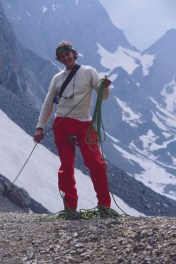 “Our fists full of topo maps and forty meters of climbing rope…. We hopped that train just as it left the station–with only thirty seconds to spare. Remember? We were pretty sure of ourselves, amigo, confident to the last tiny half minute before the only train left for the hills. And you ask ‘why’?”
I looked over to where Mont Perdido should have been–a mist of shadow clouds. As the rain ceased splashing over the front of the cave, I had almost wanted to jump off the mountain after everything, but I knew Pancho was right. It was only film, only a stupid letter. We still had our story.
The sky began to lighten, and carefully standing up, I peered around the corner. A patch of bright sunshine poked through the cloud mass, warming my face.
 “We had better get down the mountain.” Pancho said.
“Yea.” I replied sighing deeply.
“If the rains stop, we can make it down to the Parador.”
“…And have a whiskey.”
“…Maybe meet some Senoritas.”
“…And take off their clothes.”
“…And arrive in Madrid later where we will be the envy of all at the “Viva.”
“…Maybe have a whiskey.”
“…And roll a poro.”
What was the date? looking through the scratched crystal, I saw the number four through the little window on my watch.
“The Fourth of July.” I laughed.
“Como?” Pancho replied.
“Independence Day.” I said.
“A good day to be alive, no?”
“Yea, a good day to be alive.”